
Spring Cleaning Your Estate Plan: What to Toss and What to Update
By Anjali Patel
Estate Planning
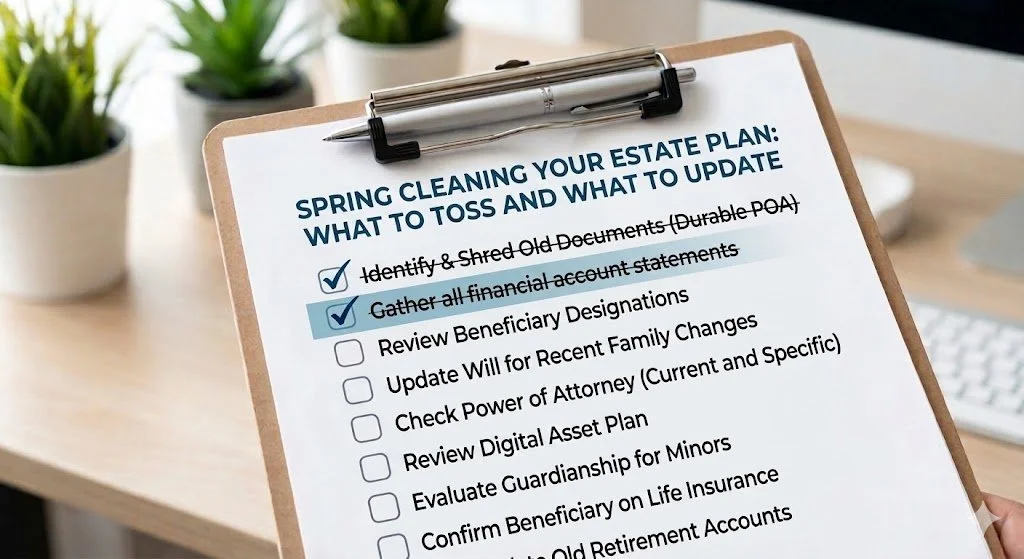
Spring cleaning your estate plan is about identifying which documents, decisions, and assumptions are outdated and updating them so they actually work under current Arizona law and your current life circumstances. For Arizona adults, this matters because estate plans don’t “age well” on their own. Laws change, families change, assets change, and the plan you signed years ago may no longer do what you think it does.
The most important legal point up front is this: an estate plan is only effective if it reflects your current beneficiaries, decision-makers, and assets under current law. If it does not, courts, financial institutions, and family members will default to statutes, old paperwork, or practical workarounds you likely never intended.
Why estate plans go stale faster than people expect
Most people assume an estate plan is a one-and-done project. In reality, estate plans become outdated through a combination of life events and quiet legal shifts that are easy to miss unless you are looking for them.
Common triggers include marriages, divorces, births, deaths, relocations, and major changes in finances. Less obvious triggers include changes in how retirement accounts must be distributed, how powers of attorney are accepted by banks, and how beneficiary designations interact with trusts under Arizona law.
Arizona’s probate and trust statutes provide default rules when documents are unclear or outdated. Those defaults may be perfectly reasonable for some families, but they are rarely tailored to your specific goals. The longer a plan sits untouched, the more likely it is that those default rules will control important outcomes.
What you can usually toss or replace
Some parts of an older estate plan are more likely to cause problems than provide protection. Spring cleaning is not about scrapping everything, but it is about recognizing when something no longer fits.
Outdated Powers of Attorney
Financial and healthcare powers of attorney are among the most frequently rejected documents when they are old. Banks and healthcare providers are cautious, and many institutions scrutinize documents that are more than a few years old.
Arizona law allows broad authority to be granted through powers of attorney, but only if the document complies with current statutory requirements and clearly authorizes the actions being requested. Financial institutions may refuse to honor documents that lack specific language or appear inconsistent with current practices. See A.R.S. §§ 14-5501 through 14-5507.
If your powers of attorney reference agents who are no longer appropriate, contain outdated addresses, or were drafted before major statutory updates, they are candidates for replacement rather than patchwork fixes.
Beneficiary Designations That No Longer Align With the Plan
Many estate plans fail because beneficiary designations were never updated while the testator was alive. Retirement accounts, life insurance policies, and payable-on-death accounts pass by contract, not by your will or trust.
If your beneficiary designations still name former spouses, deceased individuals, or minor children outright, they may override your carefully drafted trust provisions. Arizona law does not automatically fix these mismatches. Cleaning up beneficiary designations is often more impactful than revising the will itself.
Guardian Choices that no longer make sense
For parents of minor children, guardian nominations are often set once and forgotten. Over time, relationships change, people move, and health or capacity issues arise.
Arizona courts give weight to guardian nominations in a will, but they are not required to follow them if the nomination is impractical or no longer in the child’s best interests. A.R.S. § 14-5202. If your chosen guardian is no longer a realistic option, this is not something to defer.
What almost always needs to be updated, not discarded
Other parts of an estate plan usually remain structurally sound but need updates to reflect current realities.
Trust terms tied to outdated assumptions
Revocable living trusts are designed to last, but the assumptions baked into them may not. Distribution ages for children, trustee selection, and administrative provisions often reflect a snapshot in time.
For example, trusts created when children were toddlers may assume distributions at ages that no longer feel appropriate. Trustee choices may no longer be available, willing, or suitable. These provisions can usually be updated through amendments rather than full restatements, but they should not be ignored.
Tax planning provisions based on old thresholds
Federal estate tax exemption amounts have changed significantly over the past decade and continue to be a moving target. Plans that relied heavily on tax-driven trust structures may now be unnecessarily complex or misaligned with current exemption levels.
While most Arizona families are not subject to federal estate tax, outdated tax planning language can still create administrative burdens or unintended funding results. Reviewing these provisions ensures the plan reflects current law rather than expired assumptions.
Instructions for digital assets and access
Older estate plans often say little or nothing about digital assets. Today, access to email, financial accounts, business systems, and cloud storage is essential for administering an estate or managing affairs during incapacity.
Arizona has adopted laws governing fiduciary access to digital assets, but authority must be expressly granted in the documents. A.R.S. §§ 14-13101 through 14-13116. If your plan predates widespread digital account usage, this is a common gap that should be addressed.
A common question: How often should you update an estate plan?
How often should you update an estate plan in Arizona?
There is no fixed schedule, but a review every three to five years is a reasonable baseline, with immediate review after major life events. The goal is not constant rewriting, but periodic confirmation that the plan still works under current law and circumstances.
Waiting until a crisis forces action is when problems surface. At that point, options are limited, capacity may be questioned, and family conflict is more likely.
Why doing nothing is still a decision
One of the most common misconceptions is that an outdated plan is better than no plan. In practice, an outdated plan can be worse because it creates false confidence.
Family members may assume documents are valid and controlling, only to discover delays, rejections, or court involvement at the worst possible time. Spring cleaning your estate plan reduces the risk of those surprises.
This process does not require tearing everything apart. Often, it involves confirming what still works, replacing what does not, and aligning beneficiary designations and decision-makers so the documents function together.
Estate planning problems often show up at the intersection of outdated documents and incomplete follow-through. If you want to dig deeper, you may find it helpful to read about one of the most commonly overlooked steps in Arizona estate planning and why quick-fix estate planning solutions often backfire.
If you need help with your situation in Arizona, you can contact us directly here: https://www.allenlawaz.com/contact.